
Ohio Traffic Ticket Records
Ohio traffic ticket records are public court documents kept by municipal courts and county courts across the state. You can search for them online or in person at the court that handled the case. Ohio has 88 counties, and each one has its own court system that processes traffic citations. Many courts let you look up cases by name or ticket number through free search tools on their websites. The state does not run one single database for all traffic tickets. Instead, you check with the specific court where the citation was filed. For a full copy of any traffic ticket record, contact the Clerk of Courts in the right county. They can pull case files and make copies while you wait or send them by mail.
Ohio Traffic Ticket Records Overview
Where to Find Ohio Traffic Ticket Records
Traffic ticket records in Ohio are kept at the court level. Each citation gets filed with the municipal court or county court that has control over the area where the stop took place. The clerk at that court stores the case file. It holds the ticket, any plea or payment info, and the final case result. Ohio has more than 130 municipal courts and dozens of county courts, so the first step is to find out which court got your case.
The Ohio Clerk of Courts Association keeps a list of all 88 county clerks with phone numbers and addresses. That is a good place to start if you are not sure where to look. Most clerks have a Legal Division that handles court case files and a Title Division for vehicle titles. The Legal Division is the one you need for traffic ticket records. You can call, go in person, or in many cases search their website.
The Supreme Court of Ohio runs the court system at the state level. It sets rules for how courts keep records and how the public can get to them. Ohio law treats court records as public under Ohio Revised Code Section 149.43. That means anyone can ask to see traffic ticket records. You do not have to be the person named on the ticket.
The screenshot below shows the Ohio Bureau of Motor Vehicles website, which tracks points and driving records tied to traffic ticket convictions across the state.
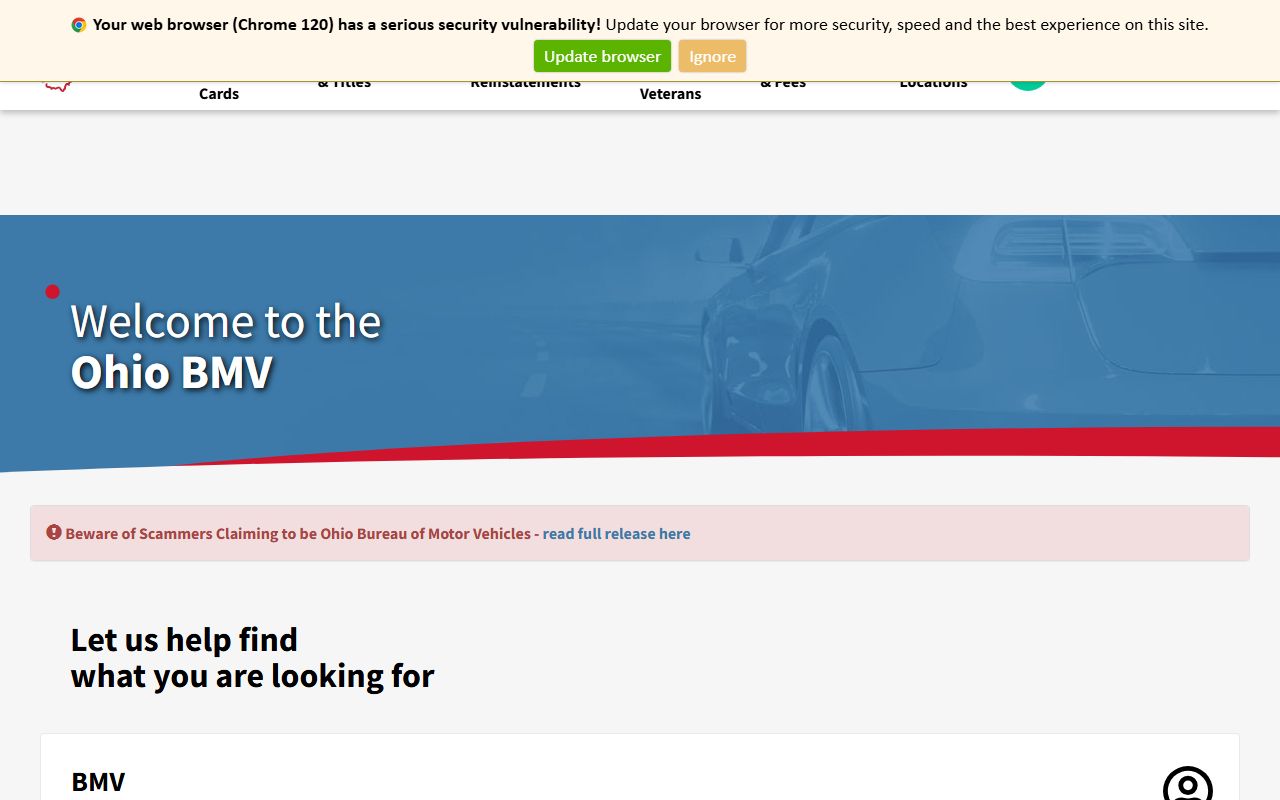
The Ohio BMV does not store the court files, but it does keep a record of every conviction that gets reported by a court. That record shows the points on your license.
Note: Ohio does not have a single statewide traffic ticket lookup system. You must check with the specific court where the citation was filed.
How to Search Traffic Ticket Records in Ohio
Searching for Ohio traffic ticket records starts with knowing which court has the case. The court name is printed on the citation. If you lost the ticket, the law enforcement agency that wrote it can tell you which court it went to. From there, you have a few ways to look up the record.
Many Ohio municipal courts have online case search tools. You can find cases by the defendant name, ticket number, case number, or driver license number. Some courts use the CourtView system, which lets you search and see case details right on screen. Larger courts like those in Franklin County, Cuyahoga County, and Hamilton County have their own search portals with more options. Each county clerk's office can also guide you on how to access traffic court records.
The screenshot below shows the Ohio Courts Network resource page for traffic court records access.
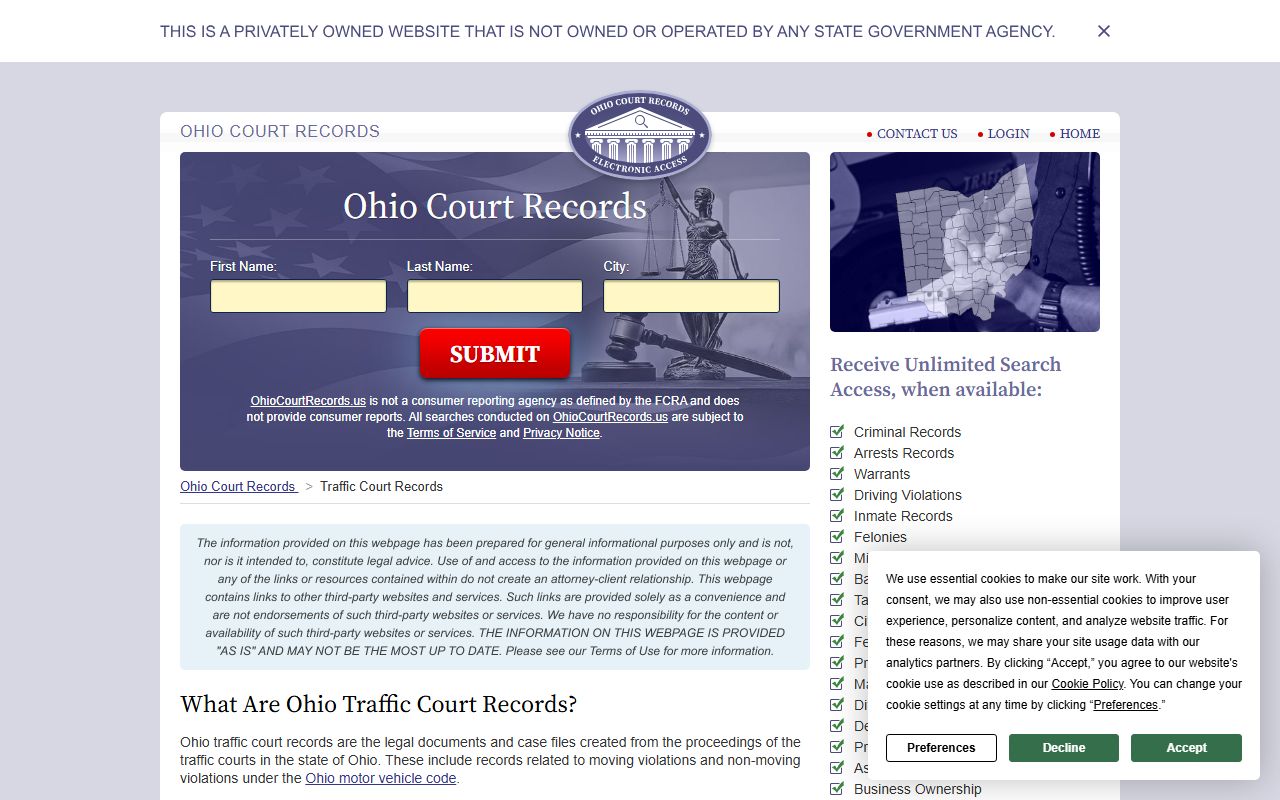
This resource explains how traffic records work across all 88 counties and where to begin your search.
To search Ohio traffic ticket records, you need:
- Full name of the person on the ticket
- The county or court where the case was filed
- Citation number or case number if you have it
- Approximate date of the violation
You can also search in person. Go to the Clerk of Courts office at the courthouse. Staff can pull up cases and make copies for you. Copy fees vary by county. Most charge $0.10 to $0.25 per page for regular copies. Certified copies cost $1.00 to $2.00 per page in most courts.
Ohio Traffic Ticket Points System
Ohio uses a point system to track traffic violations. When a court convicts you of a moving violation, it reports the conviction to the Bureau of Motor Vehicles. The BMV then adds points to your driving record. Under Ohio Revised Code Section 4510.036, the BMV must record every conviction within ten days.
Points range from two to six based on how bad the violation was. Two-point violations include things like speeding 10 to 29 mph over the limit and disobeying a traffic control device. Four-point violations cover more serious offenses such as reckless driving and speeding 30 or more mph over. Six-point violations are the worst. They include OVI convictions, leaving the scene of an accident, street racing, and fleeing from law enforcement.
The consequences add up fast. Under Section 4510.037, the BMV sends a warning letter if you hit six points within two years. If you reach 12 points in any two-year window, your license gets suspended for six months under Section 4510.036(C). A remedial driving course can remove two points from your record, but you can only do that once every three years and no more than five times in your life.
Below is a screenshot of the Ohio Revised Code section covering the points assessment system for traffic ticket convictions.
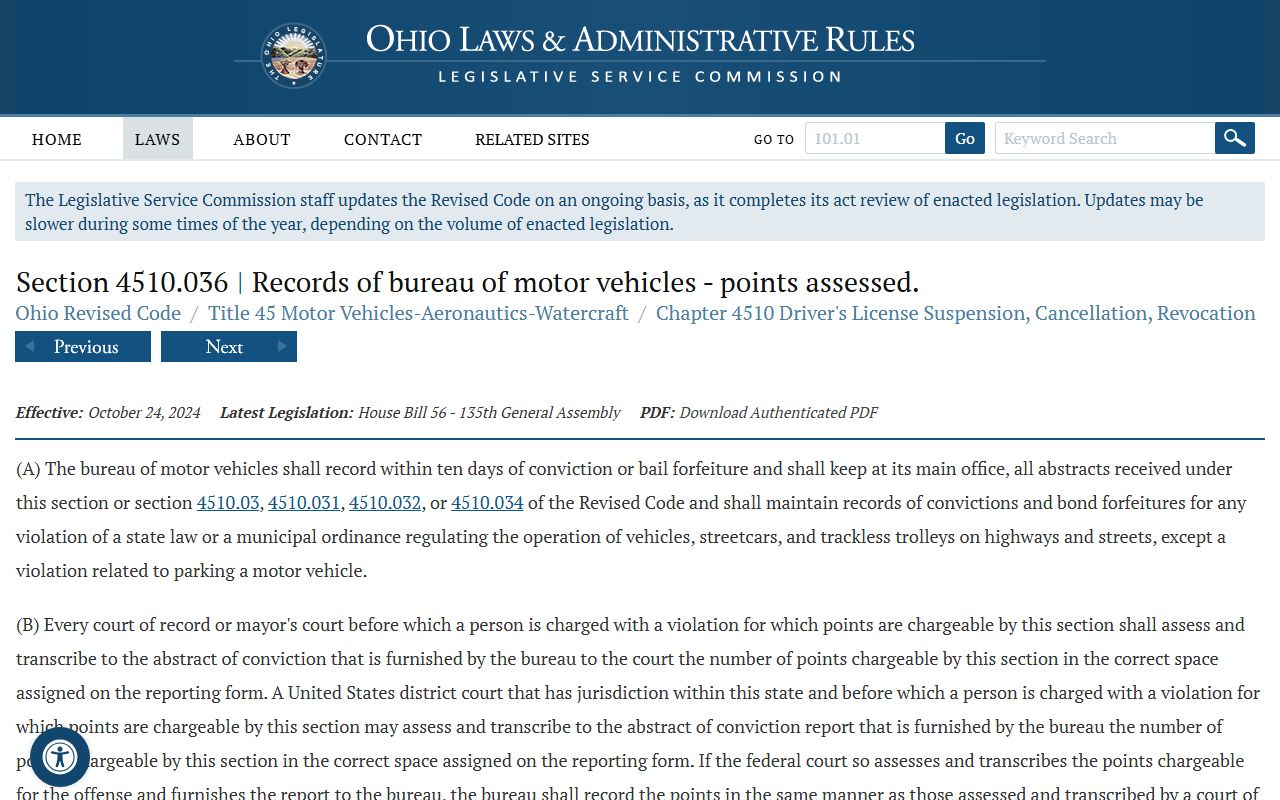
This section of Ohio law at codes.ohio.gov spells out how points get assigned and when suspensions kick in.
Ohio Traffic Ticket Court System
Traffic tickets in Ohio go through municipal courts and county courts. These are lower-level courts that handle misdemeanors and traffic violations. Municipal courts serve cities and surrounding areas. County courts cover the parts of a county that fall outside municipal court boundaries. A few places still use mayor's courts for minor traffic tickets, but those are not courts of record.
Under Ohio Revised Code Title 45, traffic laws are laid out in Chapter 4511 for rules of the road and Chapter 4510 for license and point system rules. When you get a traffic ticket, the citation tells you which court to report to. You can plead guilty and pay the fine, plead no contest, or plead not guilty and go to trial. Minor misdemeanor traffic offenses do not carry jail time. More serious charges like OVI or reckless operation require a court appearance.
The Ohio State Highway Patrol issues citations on state highways and interstates. Those tickets still go to the local municipal or county court where the stop happened. Local police and sheriff departments also write tickets that funnel into the same court system. The screenshot below shows the Highway Patrol's website.

Tickets from the Ohio State Highway Patrol get processed through whichever municipal or county court covers the area where the violation took place.
Paying Ohio Traffic Tickets
Most traffic tickets in Ohio can be paid without going to court. These are called waiverable citations. You sign the back of the ticket and pay the fine plus court costs. Many courts let you pay online, by phone, by mail, or in person. The amount depends on the violation and the court. Each court sets its own fee schedule.
Some citations are not waiverable. OVI charges, reckless operation, driving under suspension, and speeding more than 30 mph over the limit all require a court appearance. If you have had two or more moving violations in the past 12 months, your third ticket also requires you to show up in court. Failing to appear can result in a warrant and a BMV block on your license renewal.
The Ohio Legal Help website has information about paying fines and understanding court costs across all 88 counties. Citizens can also go to any Clerk of Courts office to pay traffic and criminal fines during regular business hours.
Resources at Ohio Legal Help cover the basics of court records access and payment options for every county in the state.
Ohio Traffic Ticket Records and Public Access
Traffic ticket records in Ohio are public. Under the Ohio Public Records Act, anyone can ask to see court records without giving a reason. The Clerk of Courts in each county is the official keeper of these records. They file, index, and store every case that comes through the court.
To get copies, you can visit the clerk's office, call, or in some counties submit a request by mail or email. Fees for copies vary. Standard copies run $0.05 to $0.25 per page depending on the county. Certified copies, which carry the court seal, cost $1.00 to $2.00 per page in most places. Some records may have redactions for things like social security numbers or other personal data that the law protects.
Online access is growing. More courts add search tools each year. The Ohio Department of Public Safety also maintains crash reports and works with courts on license suspensions tied to traffic convictions.

The Department of Public Safety coordinates with Ohio courts on driver licensing, point tracking, and administrative suspensions for OVI offenses.
Ohio Supreme Court and Traffic Ticket Records
The Supreme Court of Ohio sets the rules that all lower courts follow. It approves standard forms for traffic citations and publishes case time guidelines that affect how fast courts must handle traffic cases. The court also provides resources on its website for finding court info and understanding how the system works.
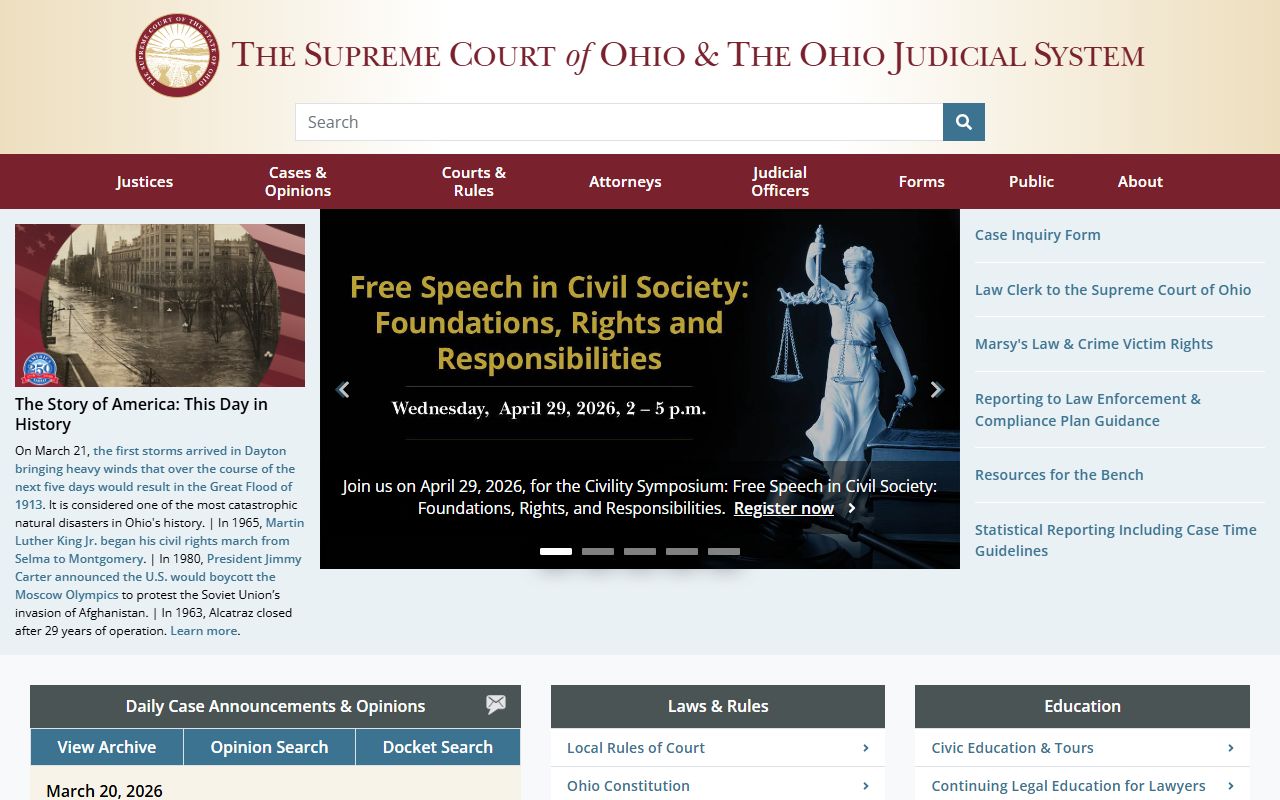
The Supreme Court oversees all Ohio courts including the municipal and county courts where traffic ticket records are kept and processed.
Below is a screenshot of the Ohio Revised Code Title 45, which contains all motor vehicle and traffic laws in Ohio.
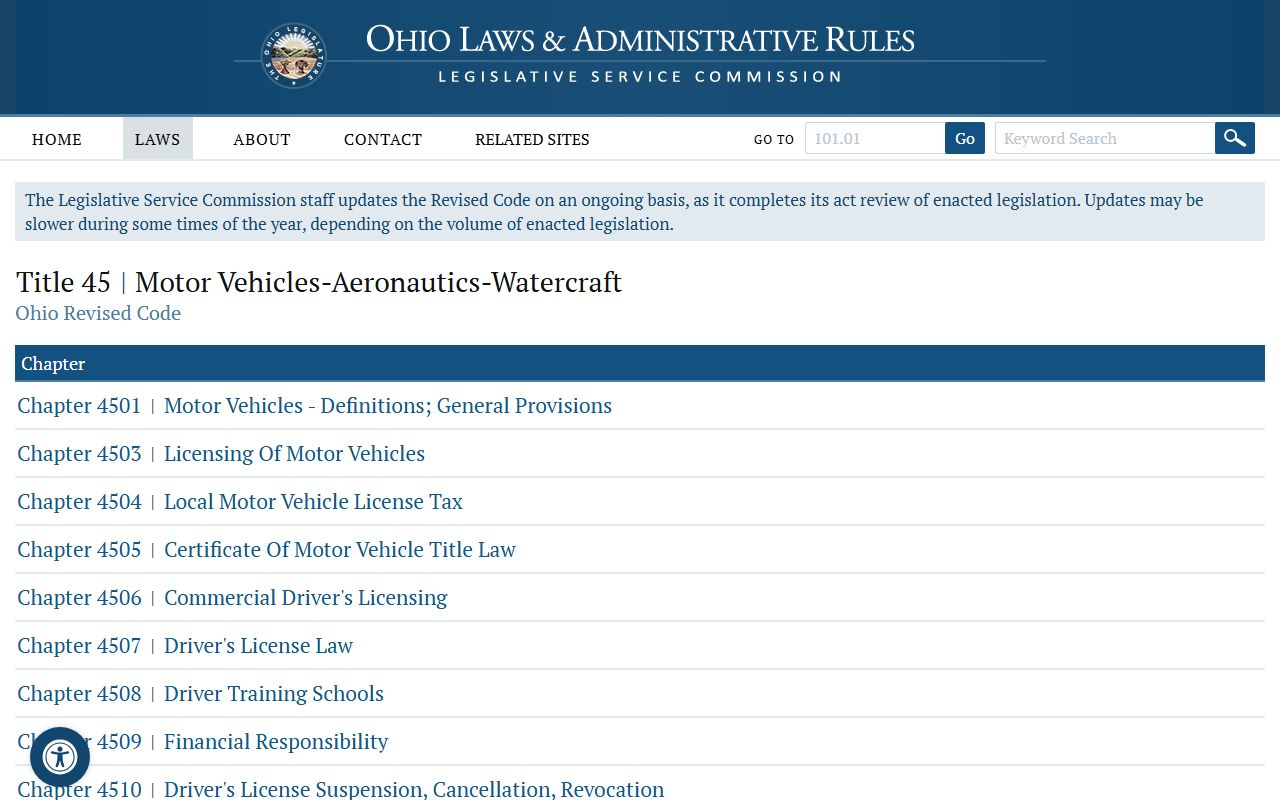
Title 45 at codes.ohio.gov covers everything from speed limits and right-of-way rules to the point system and license suspension procedures.
Ohio Clerk of Courts Association
The Ohio Clerk of Courts Association helps connect the public with the right office in any of the 88 counties. Each clerk serves as the record keeper for Common Pleas Court and in many cases also handles municipal court records. The association keeps an updated directory with contact info for every office in the state.

The directory at OCCA lists every county clerk with phone numbers, addresses, and hours so you can find the right office for your traffic ticket records search.
Browse Ohio Traffic Ticket Records by County
Each of Ohio's 88 counties has its own court system that handles traffic ticket records. Pick a county below to find local contact info, search tools, and resources for traffic ticket records in that area.
Traffic Ticket Records in Major Ohio Cities
Residents of major cities can find traffic ticket records at the municipal court serving their area. Pick a city below to find out which court handles cases and how to search for records.